
Beaufort County Criminal Records
Criminal court records in Beaufort County are centered on South Carolina Circuit Court criminal work, called General Sessions. The South Carolina Circuit Court is the general jurisdiction trial court, and its criminal side handles felony prosecutions and other criminal matters that belong beyond summary court. The Beaufort County Clerk of Court keeps Circuit and Family Court records, with the criminal division listed by the county at 843-255-5057.
Lower-level criminal matters can begin in Magistrate Court or Municipal Court. Beaufort County Magistrate Court handles traffic and criminal matters, bond, preliminary hearings, warrants, and summary court procedures. City and town municipal courts, such as Beaufort, Bluffton, Port Royal, Hardeeville, and Yemassee, handle local ordinance, traffic, and lower-level criminal cases inside their limits. When a charge becomes a General Sessions prosecution, the full criminal court record belongs with the court file, not with the jail roster.
The state Circuit Court overview is the source for South Carolina's General Sessions structure.
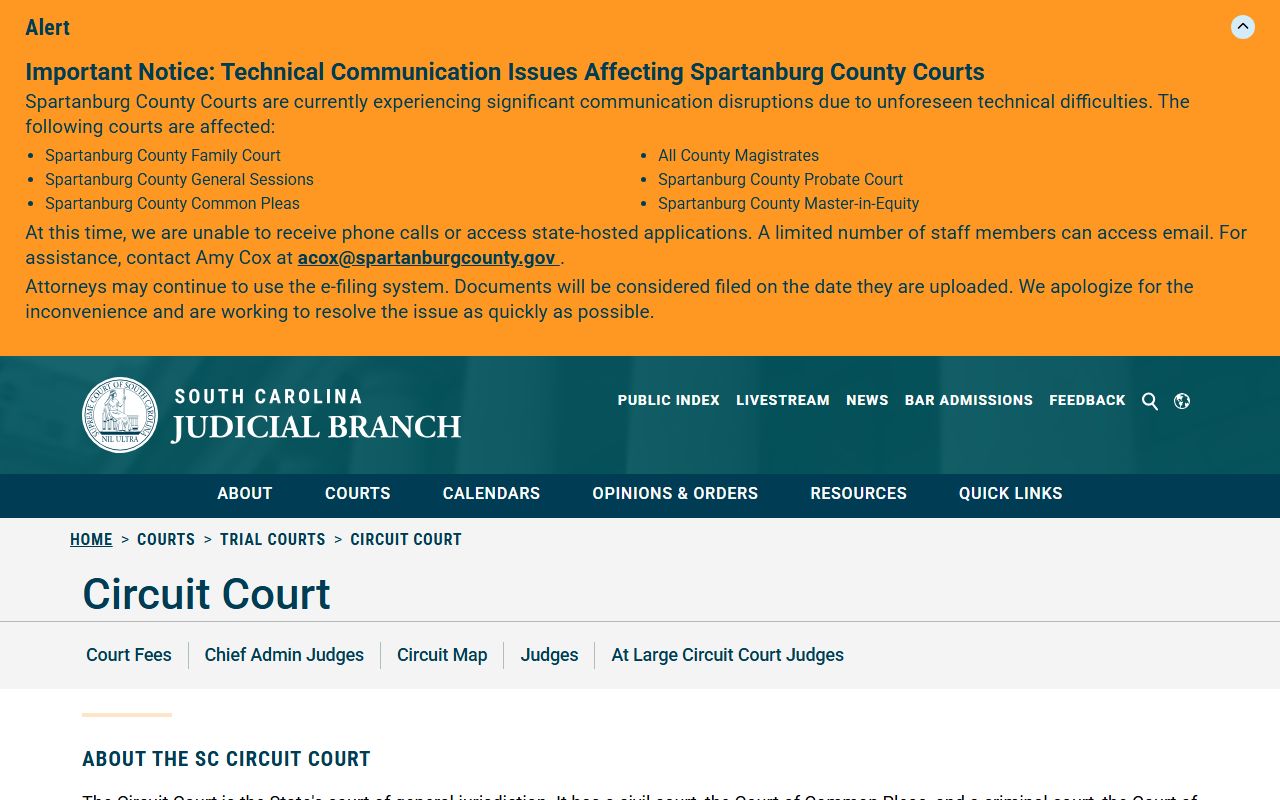
That court structure explains why Beaufort County criminal records often start in a lower court setting but end up in the Circuit Court case file for felony prosecution.
Search Beaufort County Criminal Records
The primary online route is the South Carolina Judicial Branch Case Records Search, which links to the Beaufort County Public Index. The state page identifies Beaufort County as Judicial Circuit 14 and County Number 07. The Public Index is the official place to begin for public criminal case summaries, court events, and dispositions when the case is available online. For full documents, certified copies, older files, or unclear status entries, contact the Beaufort County Clerk of Court.
- Start at the state case records search page and choose Beaufort County.
- Open the Beaufort County Public Index and search by case number or defendant name.
- Narrow results by court agency, case type, or date range when the portal allows it.
- Open the case detail and compare the charges, hearings, docket actions, and disposition.
- Request certified copies from the Clerk of Court if the record must be used for a legal purpose.
Use court rosters for calendar information and Public Index case records for case history. The Clerk page also links rosters and online payments. Beaufort County Magistrate dockets are posted by category, but the county warns they are posted one week before court and may change without notice. Court users should confirm a live court date with the issuing court, the Solicitor, the Public Defender, or counsel.
The county's Magistrate traffic and criminal court information describes plea options, trial requests, public defender timing, and summary court forms.
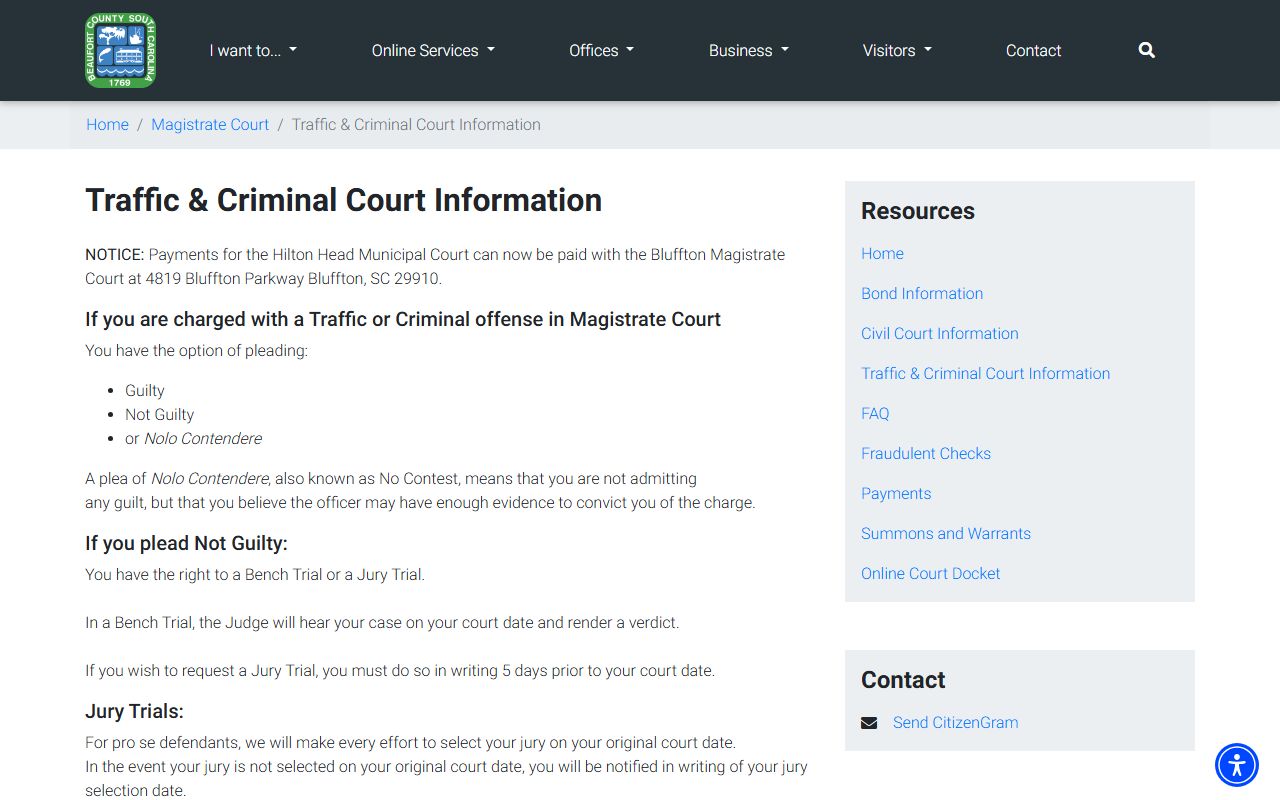
Magistrate information matters because many Beaufort County criminal records begin with bond, preliminary, traffic, or lower-level criminal proceedings before a later case record is checked in Circuit Court.
Beaufort County Criminal Case Stages
A criminal court record changes as the case moves. A charge record may show the first accusation, but the court file tracks the hearing path and final result. Beaufort County records can include an arraignment or first court setting, motions, continuances, plea entries, bench or jury trial events, disposition, sentencing, and post-disposition actions. General Sessions entries are tied to prosecution by the Fourteenth Circuit Solicitor.
Case flow: Charges Filed › Arraignment › Pretrial and Motions › Plea or Trial › Disposition › Sentencing
| Stage | What It Adds to the Record |
|---|---|
| Charges filed | The alleged offense, statute or charge text, court agency, and case number begin the court case file. |
| Arraignment or first setting | The defendant is brought into the court process and plea or counsel issues may appear. |
| Pretrial and motions | Continuances, bond issues, discovery, suppression motions, and court orders can be docketed. |
| Plea or trial | The record shows whether the case ends by plea, bench trial, jury trial, dismissal, or other court action. |
| Disposition and sentencing | The final outcome, sentence, fines, probation, or other conditions become the key record result. |
The Fourteenth Circuit Solicitor prosecutes criminal cases for Beaufort, Allendale, Colleton, Hampton, and Jasper counties.
The Solicitor's role is important when reading Beaufort County criminal court records because prosecution decisions can change charges, resolve cases, or route eligible matters into alternatives.
What Beaufort Criminal Records Show
A Beaufort County criminal court record is not one field. It is a set of linked court entries and documents. Public Index summaries may show case status and events, while complete records may require the Clerk. The South Carolina Judicial Branch has also changed public identity details: as of January 1, 2026, home address information is no longer displayed on the Public Index for new or existing cases.
| Field | What It Shows |
|---|---|
| Case number | The court's identifier for the General Sessions, Magistrate, or Municipal Court criminal matter. |
| Court agency | The division or court, such as General Sessions, Magistrate Court, or a municipal court. |
| Defendant and attorneys | The accused party and any private lawyer, public defender, or prosecutor listed in the case. |
| Charges | The alleged offenses, statute references, warrant number where available, and charge descriptions. |
| Plea | Guilty, not guilty, or nolo contendere entries when recorded by the court. |
| Events and hearings | Arraignments, motions, rosters, trial settings, continuances, and court orders. |
| Disposition | The outcome of each charge, including guilty, dismissed, not guilty, disposed, or appealed. |
| Sentence and financials | Fines, court costs, bond, probation terms, sentence details, and payment status when public. |
For a closer look at the charge line itself, including charge codes and status changes after arrest, use the Beaufort County arrest records and court charges page.
Beaufort Charges vs Convictions
A criminal charge is an accusation. A conviction is a result after a guilty plea, guilty verdict, or other court finding that creates a conviction outcome. Beaufort County criminal court records can show charges that were later amended, reduced, dismissed, or resolved through a non-conviction path. That distinction is vital when a Public Index entry or jail roster lists several charge lines from one arrest.
| Point | Charge | Conviction |
|---|---|---|
| Stage | Accusation filed or listed in court | Final result by plea, verdict, or qualifying finding |
| Record meaning | Shows what was alleged | Shows what was proven or admitted in court |
| Status can change | May be amended, reduced, dropped, or dismissed | May lead to sentence, probation, fines, or appeal |
| Best source | Charging document, docket, roster, or jail charge field | Disposition and sentencing entries in the court record |
Note: Do not treat a charge list as a conviction list unless the Beaufort County court disposition supports that result.
Beaufort County Criminal Court Help
The Fourteenth Circuit Solicitor is the chief prosecuting agency for Beaufort County and the rest of the five-county circuit. Research identifies Duffie Stone as Solicitor, with the office describing court alternatives for first-time nonviolent offenders. Pre-Trial Intervention can include community service, a prison tour, and charge-specific programming such as alcohol education. Those alternatives are not automatic record removals; the case file should be checked for the actual court result.
Public defense is handled through the Fourteenth Circuit Public Defender. The Beaufort County public defender office is at 1905 Duke Street, Suite 210, Beaufort, SC, with mailing address PO Box 525, Beaufort, SC 29901. The county lists the main number as 843-255-5000 and front office numbers as 843-255-5807 or 843-255-5821. Magistrate traffic and criminal guidance says a defendant must apply for and be appointed a Public Defender before the scheduled court date.
The Solicitor's court alternatives page explains diversion paths used in the Fourteenth Circuit.

Diversion language should be matched to the court disposition, since a Beaufort County criminal case record controls what is public and what outcome was entered.
The county Public Defender page gives the local Beaufort office and application contact route.
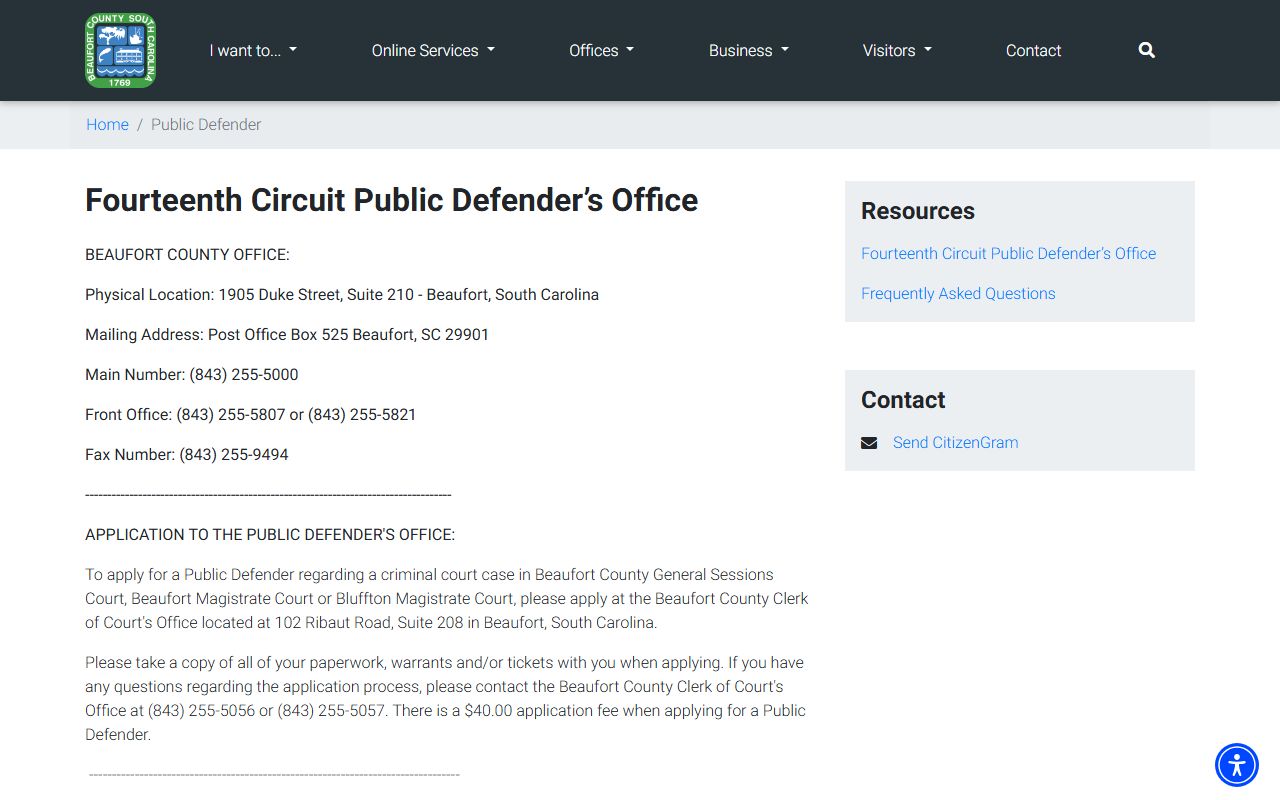
Public defender timing is part of the record access picture because counsel status can affect hearings, continuances, pleas, and future docket entries.
Sealed and Expunged Beaufort Records
Some Beaufort County criminal records are public only in part or not public at all. Juvenile matters are restricted under South Carolina juvenile law. Sealed cases are limited by court order. Expunged records are removed from public access through a statutory process. Rule 41.1 of the South Carolina Rules of Civil Procedure addresses sealing, and Rule 41.2 covers confidential information and redaction in filed material.
| Point | Sealed | Expunged |
|---|---|---|
| Public access | Blocked or limited by court order | Removed from ordinary public access after a qualifying process |
| How it happens | A motion identifies what should be sealed and why | Eligibility is checked under South Carolina expungement statutes |
| Who may still see it | Authorized parties or agencies may retain access | Internal agency limits can differ from public access limits |
| Practical step | Ask the court clerk about the order or access rule | Confirm eligibility with the Solicitor or court that handled the charge |
The official South Carolina expungement statutes are the controlling source for eligible criminal records.
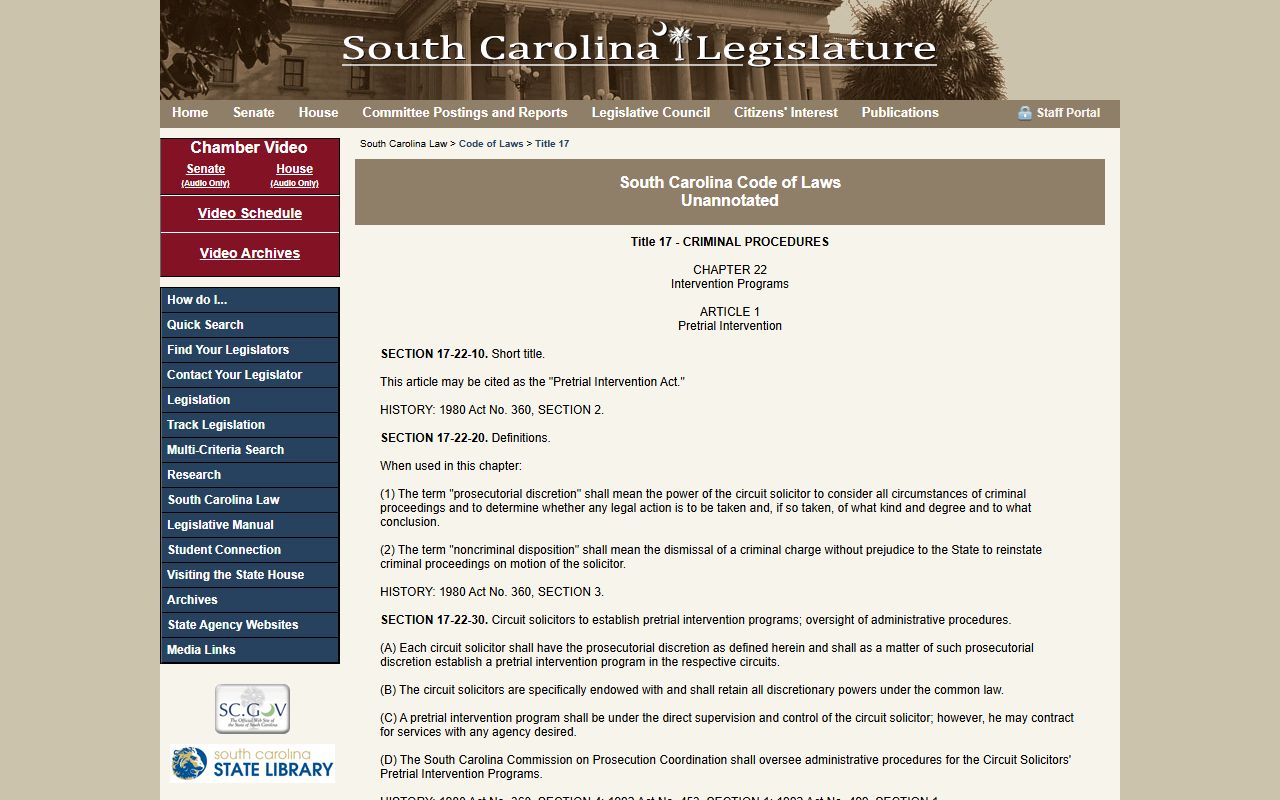
Expungement affects what a public search returns, so old Beaufort County criminal case references should be checked against the current official court file.
Public Access to Beaufort Criminal Records
South Carolina public access begins with open records principles, but criminal court records are still subject to court rules, statutes, redaction, and sealing orders. The South Carolina Freedom of Information Act gives a general public-records access framework for public bodies. Court case access also depends on the court that created the record and whether the information is restricted by juvenile law, expungement law, sealing, victim privacy, or confidential identifiers.
Key access rules:
S.C. Code Ann. Title 30, Chapter 4 sets the general public-records access framework, subject to exemptions.
S.C. Code Ann. Title 63, Chapter 19 restricts juvenile records and identifying information in defined circumstances.
S.C. Code Ann. Section 30-2-330 allows requests to remove certain personal identifying information from online official-record images.
Certified copies are not the same as online case summaries. The Beaufort County Clerk fee schedule lists a $25 records search for civil, judgment, and General Sessions records, $3 certification, $4 exemplified copy, and copy charges by page. The Clerk accepts cashier's checks, money orders, business checks, and cash with exact change, but not personal checks.
Restricted Beaufort Criminal Records
Beaufort County criminal court records may omit or limit sensitive data. Public Index home addresses are no longer displayed as of January 1, 2026. Social Security numbers, alien identification numbers, financial account numbers, minor names, victim-sensitive data, sealed records, expunged records, and juvenile material may be withheld or redacted. Body-worn camera footage is also treated separately under the Sheriff's cited Section 23-1-240 and is not a normal court record.
When a criminal case is tied to custody, the Detention Center roster may show booking data, charge descriptions, warrant numbers, bond, and court names, but that roster is not the final court case file. The full case outcome should be checked in the criminal court record, while active warrant questions should use official warrant channels rather than unofficial lists.
Note: For legal use, verify Beaufort County criminal records with the originating court, Clerk of Court, or counsel.